
How Uber blew its annual AI budget in 4 months — and how to replicate it in 90 seconds
In April 2026, Uber's CTO disclosed that the company had exhausted its full 2026 AI budget in just four months. Per-engineer costs were running between $500 and $2,000 per month. The response was fast and public: a hard $1,500 monthly cap per employee, per coding tool.
Uber's blowup is not an outlier. The same week, Axios reported that a separate unnamed tech company spent $500 million on Claude in a single month after rolling out AI licenses across engineering without usage caps. What both stories share is the same shape: a company gave engineers unmetered access to frontier AI models, cost accumulated invisibly in the backend, and finance only saw the damage 30 days later when the invoice arrived.
We built the SaaS Price Hub AI Calculator to make this kind of scenario modelable BEFORE it happens. Here's how you can reproduce Uber's exact blowup — or your own — in about 90 seconds.
Try the SaaS Price Hub AI Calculator
Open the calculator →The Uber inputs
Uber's public disclosures give us the parameters:
- Engineers using AI tools: ~5,000
- Primary coding subscription: Cursor Business ($40/user/mo)
- Primary reasoning model: Claude Opus 4.8
- Usage intensity: Heavy (matches "Cursor Pro / Claude Code power user, ~150 completions/day + agentic multi-step tasks" per the calculator's own definition)
Step-by-step in the calculator
Open saaspricehub.io/ai-calculator. You'll see two columns: Subscriptions (Column 1) and API usage (Column 2), with Your Total AI Spend accumulating on the right.
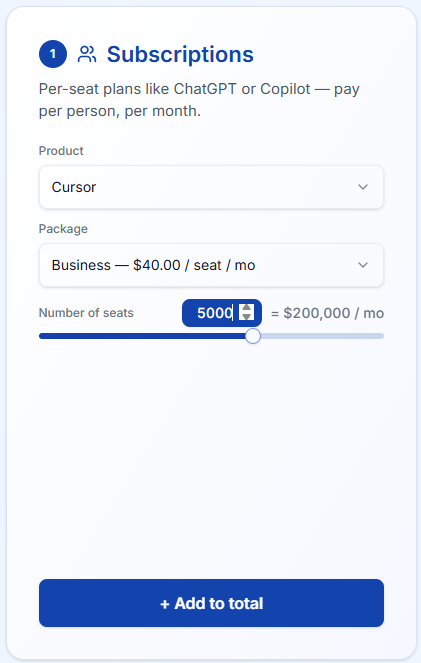
Column 1 — Subscriptions:
- Product: Cursor
- Package: Business (Uber's tier — or use Pro if you want a lower-bound estimate)
- Number of seats: 5,000
- Click + Add to total
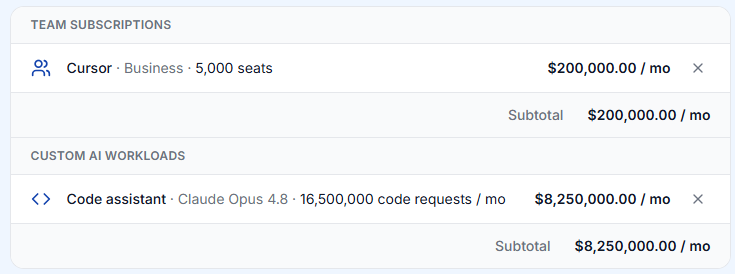
Running subtotal: ~$200,000/mo in Cursor licenses.
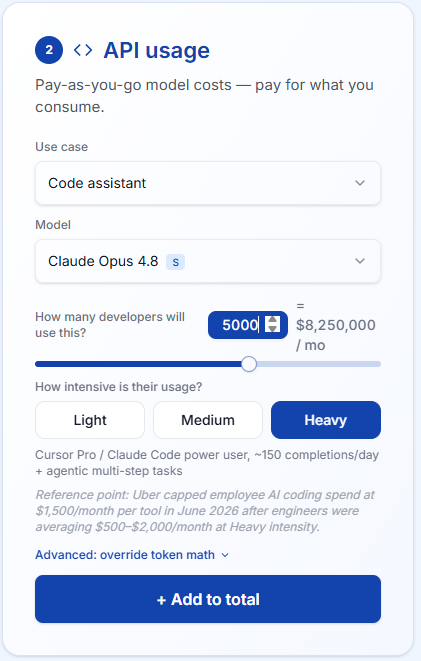
Column 2 — API usage (raw Claude consumption via Cursor + agent workflows):
- Use case: Code assistant
- Model: Claude Opus 4.8
- How many developers will use this?: 5,000
- Intensity: Heavy (the calculator explains this as "~150 completions/day + agentic multi-step tasks" — matches Uber's actual usage pattern)
- Click + Add to total
Running subtotal: ~$8.25 million/mo in raw Claude API usage.
Total AI spend on your screen: ~$8.45M per month, annualizing to ~$100M per year.
If Uber budgeted between $30M and $40M for full-year AI spend — a reasonable estimate for a company making its first serious AI push — this run rate genuinely exhausts the annual budget in about 4 months. Matches Uber's CTO's disclosure exactly.
Per-developer breakdown: ~$1,650/month at Heavy intensity. Right in the middle of Uber's disclosed $500-$2,000/month range. The calculator itself shows this reference point in the helper text, so you can validate the math against real disclosed numbers as you fill it in.
Why the numbers hit these levels
Three amplifiers pushed Uber's spend faster than anyone modeled:
Reasoning modes multiply output tokens. Claude Opus 4.8 in max reasoning mode burns 3-10× more output tokens than a straight completion. If your engineers default to the highest-quality mode — and they do — your output-token bill scales the same way.
Agent workflows chain calls. A single "code this feature" agent task can involve 5-15 model calls (planning, execution, review, retry). Each one runs the full context window. What looks like one interaction on the frontend is often 10-30 API calls in the backend.
Nobody sees the bill in real time. OpenAI and Anthropic bill monthly. Engineers have no visibility into their own token consumption while working. Finance sees the number 30 days later — and by then, the damage is baked in.
How to avoid Uber's fate
Three practical moves any team can implement this week:
- Set per-employee caps on AI subscriptions and API access before deploying. Uber capped at $1,500/employee/month AFTER the crisis. Do it before.
- Route lower-value tasks to cheaper models. As Chamath argued on the All-In podcast last week: 98% of Fable prompts should be running on a cheaper model. The SaaS Price Hub AI Calculator lets you compare cost-per-workload across Claude Opus 4.8, GPT-5.6 Sol, and cheaper alternatives like Nova Micro or Command R7B in seconds.
- Model your worst-case scenario at 10× current usage. Take your projected monthly volume and multiply by 10 — that's your realistic peak once engineers start using agent workflows aggressively. Budget for that number, not your baseline.
Try it yourself
Model your own scenario in under 2 minutes.
Change the model, the volume, the intensity — and see what your company's blowup would look like before it happens.
No sign-up required · USD or EUR · Alerts available for any tracked model
Get the weekly newsletter
Every Friday. 4-minute read. Free, no spam.
Browse the full price tracker →
Pricing Pulse is SaaS Price Hub's weekly analysis of SaaS and AI pricing moves. Data sourced from our tracker and verified against official vendor pricing pages.